
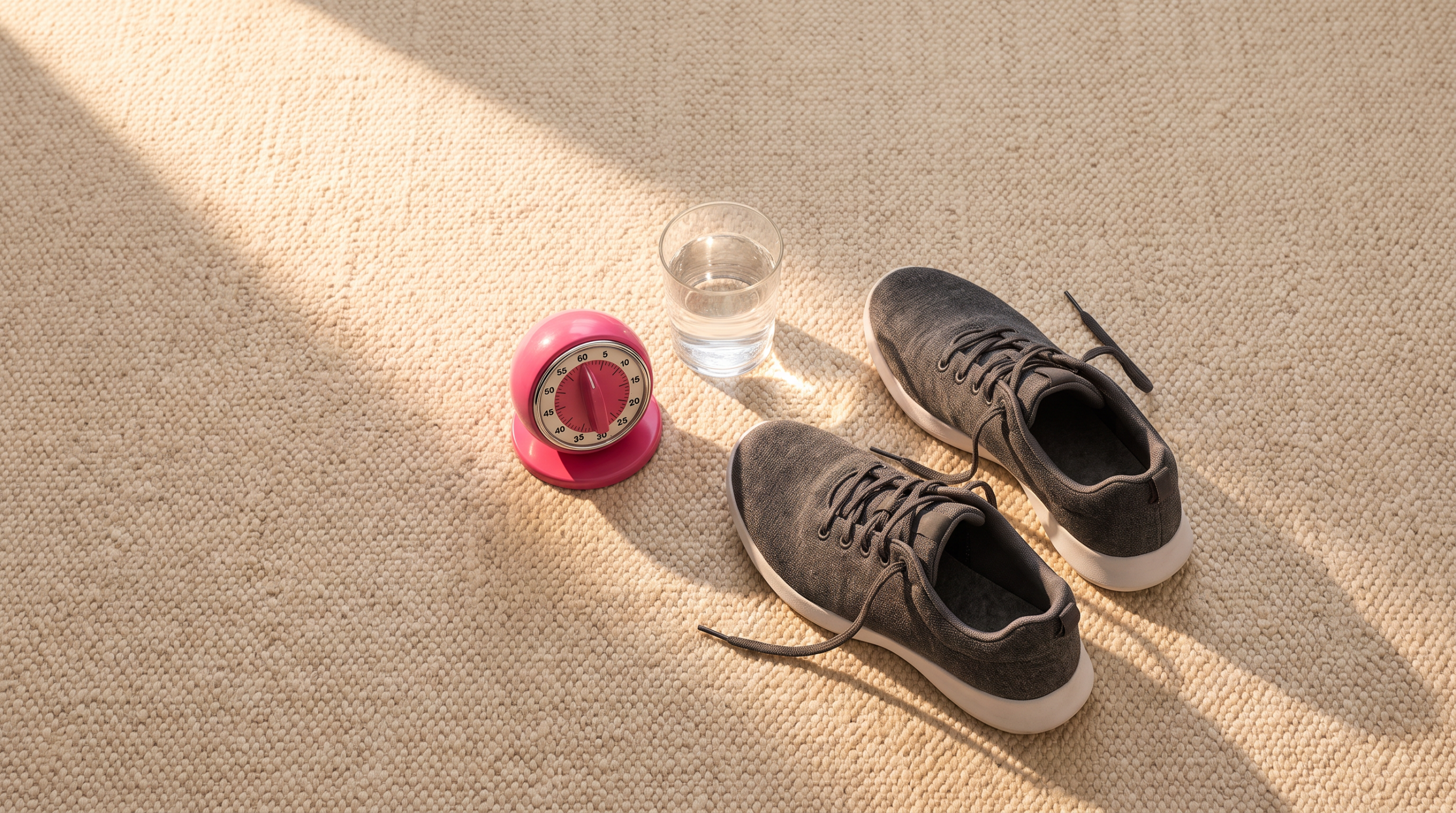
It’s 2:47 PM. You are on your third coffee, your inbox is judging you, and you are one snack-drawer away from calling it. Bestie, I see you. Okay wait, hear me out: the afternoon slump is not a personality flaw, a lunch problem, or proof that you should have gone to bed earlier. It is a scheduled event on your biology’s calendar — and if you want to know how to beat the afternoon slump, you have to stop fighting the clock and start working with it.
The move is smaller than any productivity guru will admit. Actually, it is three tiny moves. And they take less than fifteen minutes!
Why This Matters: your 3 PM crash is a clock, not a vibe
Everyone online will tell you the afternoon dip is about blood sugar, or the sandwich you ate, or that you “need more discipline.” Plot twist: the research says otherwise.
The most cited review of the post-lunch dip — Timothy Monk’s 2005 paper in Clinics in Sports Medicine — put it in black and white: the mid-afternoon dip in performance and alertness is real, it is measurable, and it occurs even when the individual has had no lunch and is unaware of the time of day (Monk, Clinics in Sports Medicine, 2005). Take away the sandwich, take away the clock — the dip still shows up! Your biology scheduled this.
Earlier work from the same lab traced why. In a controlled study published in Chronobiology International, Monk and colleagues tracked participants across a routine where lunch was replaced by hourly liquid supplements (so calorie intake stayed constant) and found that people who dipped had a stronger 12-hour harmonic in their circadian rhythm — a second, smaller trough sitting inside the 24-hour cycle. Their body temperature stayed flat from 10 AM to 3 PM instead of rising like the non-dippers (Monk et al., Chronobiology International, 1996). Translation for your Tuesday: your suprachiasmatic nucleus (aka your body clock, running the show from a tiny cluster in your brain) briefly eases off the alerting signal in the early afternoon. It is a feature, not a bug.
Once you know the mechanism, “just push through” starts to sound like fighting your own hardware. And your hardware is going to win every time.
The 15-minute reset: three tiny moves that actually work 🚶
Here is where it gets fun! Sleep researchers have quietly figured out what beats the dip — and it is not another latte. In a randomized trial in the Journal of Sleep Research, twenty adults were cycled through four conditions: normal night sleep, extended night sleep, a short afternoon nap, and 150 mg of afternoon caffeine. Result: naps, caffeine, and sleep extension all reduced the afternoon dip on the Multiple Sleep Latency Test — but the short nap was the most effective, and its benefits held until mid-evening. A 15-minute nap outperforming extra night sleep, and honestly? Obsessed. (Horne, Anderson & Platten, Journal of Sleep Research, 2008).
The receipts (aka the actual studies) point at three cheap, boring, non-supplement moves. Stack them.
Move 1: The 10-minute walk (yes, that boring)
I know, everyone says “just walk.” Okay but the data actually holds up. Across four experimental studies with 298 total participants, 10-to-15-minute bouts of walking produced significant increases in energetic arousal and shifts toward more positive affect — with the energizing effect landing right at the walk itself and a calming after-effect during recovery (Ekkekakis, Hall, VanLanduyt & Petruzzello, Journal of Behavioral Medicine, 2000).
Not a run. Not “get your steps in.” Ten minutes, brisk-ish, ideally outside or at least somewhere with actual light on your face. The smallest version that still counts: one lap of the block, or up-and-down your longest hallway if the weather is not participating.
Move 2: Light on your face, not just your screen
While you are walking, the second thing is happening for free — your eyes are getting real light. In a workplace study in Physiology & Behavior, participants who worked under high-illuminance lighting (1000 lux) versus dim light (200 lux) reported less sleepiness, felt more vital and energetic, had shorter reaction times on a psychomotor vigilance task, and showed elevated heart rate and altered heart-rate variability consistent with higher physiological arousal (Smolders, de Kort & Cluitmans, Physiology & Behavior, 2012).
Your indoor office is probably running at 200–500 lux. A cloudy day outside is 10,000 lux. Going outside for even a few minutes during the dip window is a real intervention, not a self-care aesthetic! Fifty times the light, for free.
If outside is truly not happening (winter, meeting, whatever), open blinds and sit by a window for five minutes. Fluorescent overhead lighting is not enough on its own.
Move 3: The coffee nap (only if you can)
Here is the receipt-heavy version of “just take a nap.” In a 1997 study in Psychophysiology, Reyner and Horne tested 12 sleepy drivers in a monotonous 2-hour afternoon driving simulator after a 30-minute break. Compared with placebo, caffeine alone reduced driving incidents to about 34% of placebo levels. Caffeine plus a short nap under 15 minutes dropped incidents to 9% of placebo — a stronger effect than caffeine alone or nap alone (Reyner & Horne, Psychophysiology, 1997). The trick is the timing: caffeine takes 20–30 minutes to reach peak effect, and a nap under 20 minutes usually stays out of the deeper sleep stages that cause post-nap grogginess. Drink, then rest. You wake up as the caffeine kicks in.
This is the “if you have any flexibility whatsoever” tier. Work-from-home Wednesdays, weekends, students between classes — this is the one.
Common Mistake: fixing your morning to fix your afternoon
The classic move when the 3 PM slump keeps happening is to go back and mess with your morning — “maybe I need to wake up earlier,” “maybe I need a different breakfast,” “maybe I need to skip lunch entirely.” Save the effort. That same Journal of Sleep Research trial found that extending night sleep by up to 90 minutes helped the afternoon dip less than a short afternoon nap or afternoon caffeine (Horne, Anderson & Platten, Journal of Sleep Research, 2008). More sleep the night before is great for a lot of things. It is not the highest-leverage lever for the dip specifically. The highest-leverage lever is what you do inside the dip window itself.
Also — please — the answer is not a fourth coffee at 4 PM. Caffeine has a half-life of roughly 5–6 hours. A 4 PM latte is still 25–50% active in your system at 10 PM, which is a tax on the sleep you are already going to blame tomorrow’s slump on.
Try This This Week
Pick your dip window. For most people it starts 7–9 hours after waking, so if you’re up at 6 AM, plan for 1–3 PM. If you’re up at 8 AM, plan for 3–5 PM.
Then, for the next seven days, run the smallest version:
- Day 1–3: Just the walk. Ten minutes, outside if possible, during your dip window. That’s it.
- Day 4–5: Add the light exposure. Walk on the sunny side of the street. Sit by a window when you get back. No screen for five minutes after.
- Day 6–7: If your schedule allows, try one coffee nap. Small coffee, then set a 20-minute timer, lie down or sit reclined in a quiet room. If you can’t nap, just rest with your eyes closed — the 1997 study found “nonsleep dozing” still worked (Reyner & Horne, Psychophysiology, 1997).
Miss a day? Nothing broke. Start with the next dip. She’s staying — the habit, not the drama.
After a week, ask one question: did the 3 PM cliff feel less like a cliff? If yes, that’s your new default. If no, adjust the setup, not your opinion of yourself. Move the walk earlier. Move the coffee later. Make the smallest version smaller.
The Shift ✨
The afternoon slump is a body-clock event, not a character test — the fix is a tiny, timed reset, not more willpower.
Habit Guide — September 2026
Leave a Reply