
Okay wait, hear me out, bestie. It’s Halloween night. The kids have been trick-or-treating for two hours, the candy bowl is empty, and suddenly everyone is bouncing off the walls. 🍬 Case closed, right? Sugar did it!
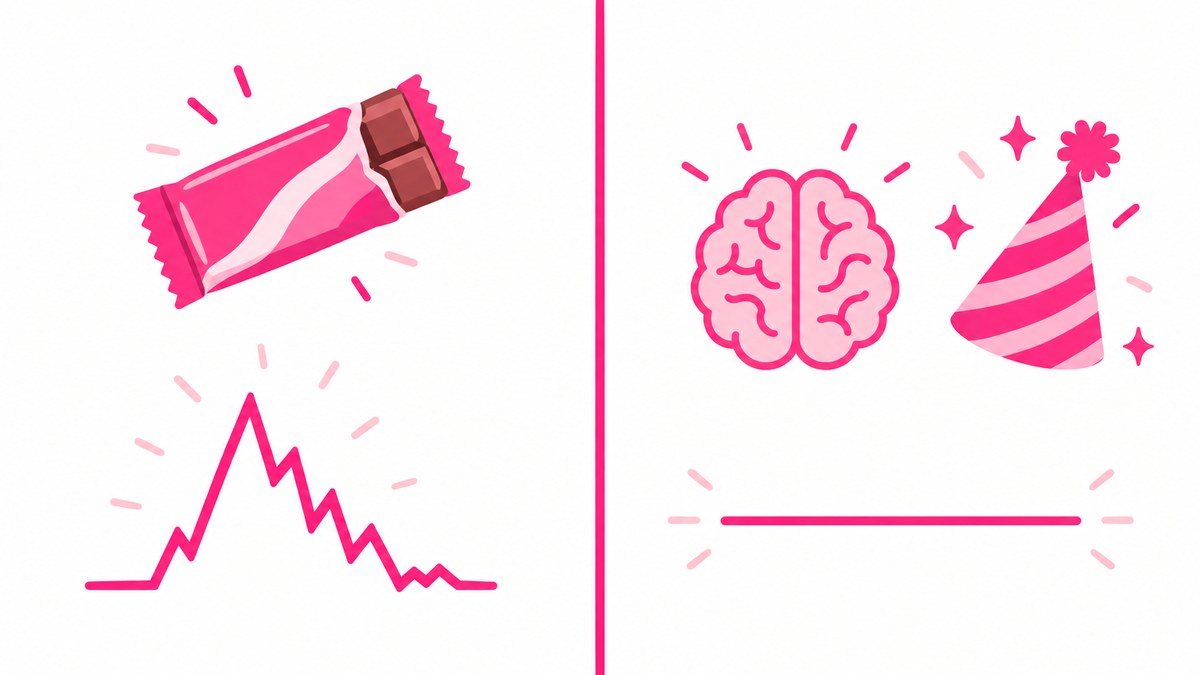
Plot twist: the research says probably not. So does sugar make kids hyper? Here’s the Myth Check version: the sugar rush isn’t a chemical high. It’s the party, the excitement and, honestly, what the grown-ups expect to see. And that’s actually great news, because it means you can enjoy Halloween without bracing for a sugar meltdown.
Why this matters
The sugar-equals-hyper idea is one of the most popular parenting beliefs out there. It’s so common that two pediatric researchers put it on their list of festive medical myths in the BMJ, right next to holiday classics that also don’t hold up (Vreeman & Carroll, BMJ, 2008).
Why does a myth matter if candy is still candy? Because when we blame sugar for every wild moment, we miss what’s really going on. A kid who’s overtired, overstimulated or just super excited needs a different kind of help than a kid who “ate too much sugar.” Getting the reason right makes the fix way easier. ✨
The receipts (aka the actual studies)
This is not a one-study situation. Researchers have tested this question for decades, and the good studies have one thing in common: nobody in the room knows who got the sugar.
The big one is a 1995 meta-analysis in JAMA. Mark Wolraich and colleagues pulled together 16 reports covering 23 studies where kids got either a known amount of sugar or a placebo sweetener, with the kids, the parents and the researchers all kept in the dark about which was which (Wolraich et al., JAMA, 1995). Across 14 different measures of behavior and thinking, they found no reliable effect of sugar. The authors were careful to say a small effect in some kids couldn’t be ruled out, but the overall answer was no.
The year before, the same research group ran an even more intense test in the New England Journal of Medicine. Families followed three different diets for three weeks each: one high in sugar, one sweetened with aspartame and one with saccharin. The study included 25 preschoolers and 23 school-age kids whose parents described them as sugar-sensitive. Nobody knew which diet was which, and the high-sugar weeks didn’t change the kids’ behavior or thinking (Wolraich et al., NEJM, 1994).
What this means for your Tuesday: even with kids whose parents were sure sugar set them off, the effect didn’t show up when nobody knew what they’d eaten.
Myth check: the sugar rush lives in our expectations
So where does the sugar rush come from? This is the part that hits different once you know the mechanism.
In a 1994 study, researchers worked with 35 boys aged 5 to 7 whose mothers described them as “sugar sensitive.” Every single boy got a sugar-free drink. But half the mothers were told their son had just had a big dose of sugar (Hoover & Milich, Journal of Abnormal Child Psychology, 1994).
Those mothers rated their sons as significantly more hyperactive. They also stayed physically closer and tended to criticize and talk to their sons more. Same drink, same kids, different expectation, and the “sugar high” showed up anyway. 🤯
Our brains are pattern-matchers. If we believe sugar causes chaos, we notice every bounce after a cupcake and forget the calm afternoons after cookies. Plus, sugar usually arrives at the most exciting moments of a kid’s year: birthday parties, sleepovers, holidays and Halloween night. The sugar didn’t make the party exciting. The party was always going to be exciting.
So what actually revs kids up on Halloween?
If it’s not the sugar, what is it? A few very real things stack up on the same night.
First, excitement itself. Costumes, surprises and a giant bag of treats light up the brain’s reward system, the dopamine circuits that respond to novelty and anticipation. That buzz is real, it just comes from the experience, not the ingredient list.
Second, timing. Trick-or-treating usually runs past a kid’s normal bedtime, which pushes against their circadian rhythm, the internal clock that tells the body when to wind down. An overtired kid often looks wired rather than sleepy.
Third, cognitive load. Crowds, noise, flashing decorations and a dozen strangers at a dozen doors is a lot of input for a small brain to sort through. Put all three together and you get chaos, no sugar required!
Common mistake: thinking “no rush” means “no limit”
Here’s the caveat, friend, and it’s an important one. Busting the sugar-rush myth does not mean sugar is a free-for-all.
The American Heart Association recommends that kids ages 2 to 18 keep added sugar under 25 grams a day, about 6 teaspoons, and that kids under 2 skip added sugar entirely (Harvard T.H. Chan School of Public Health, on the AHA statement in Circulation, 2016). The reasons are long-term: heart health, weight and teeth, not behavior.
Also, this myth check is about everyday kids and typical treats. If you’re worried about a child’s attention or behavior, that’s a conversation for your pediatrician, not a candy bowl.
How to handle Halloween with the real science
The smallest version that still counts: change what you expect, and the night changes with it.
- Plan for the excitement, not the sugar. Costumes, late nights and crowds are a lot for little brains. Build in a calm-down routine before bed, like a bath or a story.
- Pair treats with a real meal. Candy right after dinner fits more easily into the day than candy on an empty stomach.
- Keep the 25-gram guideline in mind for the days after Halloween. A couple of fun-size pieces a day is easier to manage than the whole bag at once.
- Notice your own narrative. If you catch yourself saying “it’s the sugar,” pause and check: are they tired? Overstimulated? Just having a blast?
Try this this week
- Pick one treat moment and watch what actually happens, without saying the word “sugar” out loud.
- Write down the setting: time of day, how much sleep, what else was going on.
- Compare it with a non-treat moment at the same time of day.
- Choose one calm-down ritual for after trick-or-treating and keep it simple.
The Shift
The sugar rush isn’t in the candy. It’s in the costume, the crowd and the story we tell about it. Let’s go! 🎃
Myth Check — Dana Whitfield, October 13, 2026
Leave a Reply